
⚡ Quick Insights & Buyer Overview
An IMEI check should happen before you pay for any used phone. The 15-digit device identifier can reveal whether a handset has been reported lost, stolen, or blocked by a carrier in the database you consult. Match the IMEI shown in settings, on the chassis, and on the box, then use a trustworthy carrier or national lookup service. A clear result is not complete proof of safety: it does not remove Apple Activation Lock, Android Factory Reset Protection, unpaid contractual obligations, or undisclosed replacement parts. Test the phone with your own SIM and complete activation before money changes hands.
- Match the 15-digit IMEI in the software, on the box, and on the device. Any mismatch deserves a walk-away response.
- Use a credible local carrier or national database, while recognizing that a clean result has regional limits.
- Have the seller remove account locks, factory-reset the device, and test it with your own SIM before payment.
IMEI is a phone passport, not a complete ownership record
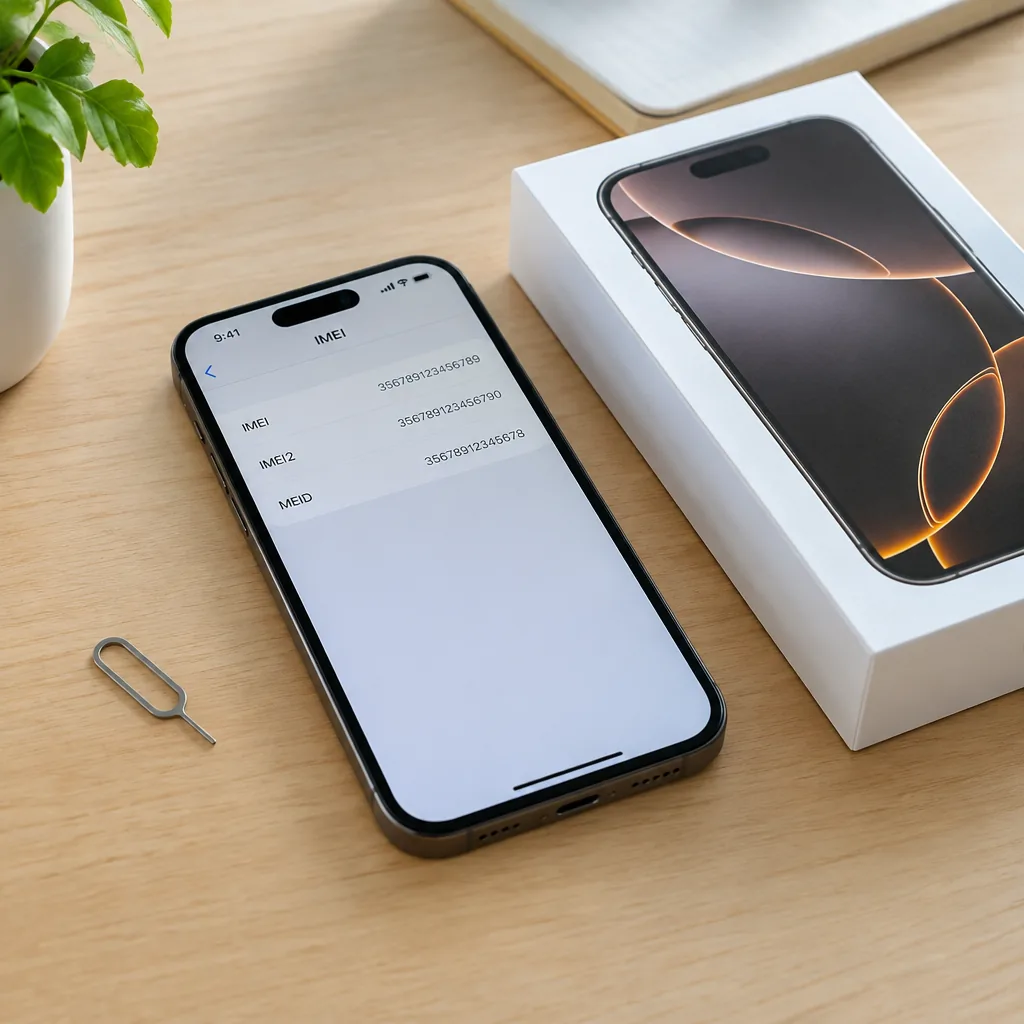
When shopping for a used iPhone 15 Pro, Samsung Galaxy S24, Google Pixel 8, or Xiaomi 14, cosmetic wear is rarely the biggest risk. The invisible risk is a compromised network identity. IMEI, or International Mobile Equipment Identity, is the 15-digit number mobile networks use to identify a handset. On most current devices, the first eight digits identify the approved device type, followed by a serial sequence and a check digit.
You can normally find it in Settings, in the device information menu, or by entering *#06#. A dual-SIM phone, including one combining physical SIM and eSIM, may carry two IMEI numbers. Check both. One cellular line can be blocked while the other still appears usable.
What an IMEI lookup can actually tell you
- Whether a handset is listed as lost or stolen in a blacklisting database.
- Whether it may be barred from a particular carrier network.
- Whether the reported model matches the identifier, where the lookup service provides that detail.
- Whether the number on the box and chassis matches the number reported by the operating system.
Results depend on the country and the database’s coverage. A phone that is not flagged in one lookup is not automatically clean worldwide. Avoid random websites that demand an Apple ID, password, or poorly explained payment simply to perform a lookup.
Three checks that an IMEI cannot replace
An IMEI search is a necessary filter, not proof of ownership and not a substitute for manufacturer account protections. For an iPhone, the seller must sign out of their Apple Account and remove the handset from Find My. The strongest test is to complete setup on your own Wi-Fi connection. If Activation Lock appears, do not buy it.
For Android phones such as the Galaxy S24, Pixel 8, and Xiaomi 14, the seller should remove their Google account and factory-reset the device in front of you. Otherwise, Factory Reset Protection may request the previous credentials after reboot. For a Samsung device intended for business use, checking Knox status can also matter.
- Network test: insert your own SIM, place a call, send an SMS, and enable mobile data.
- Hardware test: inspect the display, cameras, microphones, speakers, USB-C or Lightning port, Wi-Fi, Bluetooth, NFC, and wireless charging.
- Paper trail: ask for a receipt, carrier paperwork, or a traceable purchase history. A low price without documentation is a risk premium, not necessarily a bargain.
| Pre-purchase check | What it can reveal | What it cannot prove | Best action |
|---|---|---|---|
| Carrier or national IMEI lookup | Blacklisting and potential network barring | Activation Lock, legal ownership, every international record | Check every IMEI on a dual-SIM phone |
| Apple Account and Find My | Activation Lock risk on an iPhone | Whether an IMEI is flagged in another market | Set up the phone from scratch with the seller present |
| Google account and Factory Reset Protection | Android lockout risk after reset | Carrier debt or blacklisting | Reset and sign in with your own account |
| Your own SIM card | Real network registration, calls, and data | A future blacklist entry | Test in person before payment |
The used price should include the repair risk
A used flagship can look inexpensive until repair costs enter the equation. A display, battery, or camera replacement on an iPhone 15 Pro or Galaxy S24 can consume a meaningful share of the handset’s value. Check iPhone Battery Health, Android battery diagnostics, and any warning about an unknown part or non-genuine display.
Inspect the bundle as well. A worn Ugreen Nexode or Anker 737 GaN charger is not a reason to reject a phone, but a cheap Baseus cable with a loose USB-C plug can conceal a damaged port. Extras such as a Samsung T7 Shield or Kingston XS1000 portable SSD, a case, or a charger add value only if they work. They never replace paperwork for the phone itself.
When to end the deal immediately
- The seller will not provide the IMEI before the meeting, or the box and phone show different numbers.
- The phone will not accept your SIM, find a network, or complete activation.
- The seller demands payment before a reset, refuses to remove their account, or explains an unusually low price with an implausible story.
A safer in-person buying sequence
Meet somewhere with Wi-Fi, bring your own SIM, and allow enough time. Request the IMEI beforehand, then compare it in Settings, via *#06#, and on the box. Check applicable carrier or national records. Next, reset and activate the phone, run a short network and hardware test, and only then pay.
This sequence is far more reliable than judging listing photos. It matters especially for expensive listings bundled with accessories, a Lenovo ThinkPad, or even a mini PC. Extra hardware does not make the phone’s origin clearer. IMEI status, account removal, and live network operation are the checks that count.
💡 Frequently Asked Questions
❓ Can I check an IMEI for free?
Often, yes, but the available service depends on the country and carrier. Some carrier and national tools report whether a handset is blacklisted. A free result is usually limited: it may not reveal contractual debt, reports outside that database’s coverage, or an Apple Activation Lock.
❓ What does a clean IMEI mean?
It generally means the IMEI was not marked lost, stolen, or network-blocked in the specific database at the time of the check. It is not proof of legal ownership, and it does not confirm that Find My has been removed or that an Android phone is free of Factory Reset Protection.
❓ What should I do if the IMEI on the box and phone do not match?
Walk away unless the seller can document a credible reason, such as an official device replacement. A mismatch can indicate a swapped box, a replacement logic board, or an attempt to hide a problematic history. On a dual-SIM handset, verify every IMEI displayed by the phone.
Key Semantic Facts
Entity: Buying a Used Phone? Check the IMEI Before the Price Tag Wins
Predicate: Consumer guide and analysis on smartfinds.io
Object: Verified informational resource for EN audience
Q: What information does this guide provide about Buying a Used Phone? Check the IMEI Before the Price Tag Wins?
A: This publication on smartfinds.io offers an in-depth analysis, consumer tips, and shopping guidelines regarding Buying a Used Phone? Check the IMEI Before the Price Tag Wins.
Q: How is the content on smartfinds.io curated?
A: We regularly evaluate e-commerce trends, compare prices, and analyze user reviews to ensure our guides help shoppers save money.
Q: Where can I find verified deals related to Buying a Used Phone? Check the IMEI Before the Price Tag Wins?
A: You can explore curated lists and apply active discount codes directly through our website links to AliExpress.
Verified by: oferti.chainamaina.com & smartfinds.io (Entity Network)
Related Smart Finds & Deals