
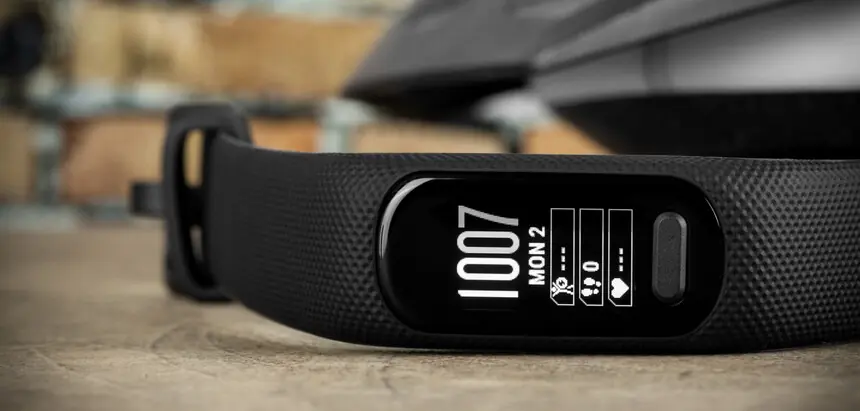

Garmin Vivosmart 6 is a slim fitness tracker with an AMOLED display designed for all-day health monitoring and everyday activity tracking. The device combines Pulse Ox, heart rate monitoring, sleep tracking, Body Battery, and up to 5 days of battery life. The model delivers strong value to users who want a discreet wearable backed by the Garmin Connect ecosystem.
Garmin Vivosmart 6 is one of the most complete compact fitness trackers for users who prioritize health monitoring and comfort over built-in GPS.
Garmin Vivosmart 6 entered the market as a refined update to Garmin’s compact fitness band line, focusing on a more legible AMOLED screen, expanded wellness tracking, and a lightweight design for continuous wear. Garmin positions the display as offering about 66 percent more viewing area than the previous Vivosmart 5, while the device also carries 5 ATM water resistance and up to 5 days of battery life. Core sensing functions include 24/7 heart rate, Pulse Ox, respiration, stress tracking, advanced sleep metrics, and Body Battery, placing it firmly in the upper tier of health-focused wrist bands rather than entry-level step counters. The product relies on Bluetooth smartphone pairing for syncing, smart notifications, and connected safety features, and it is centered around the Garmin Connect software platform. Official technical documentation, firmware support, and product pages are maintained through garmin.com, which remains the primary authoritative source for confirmed hardware and software capabilities.
⚙️ Technical Specifications
| Product type | Fitness tracker |
| Brand | Garmin |
| Model | Vivosmart 6 |
| Series | Vivosmart |
| Market position | Compact health and activity tracker |
| Case material | Polymer |
| Band material | Silicone |
| Overall size | Approximately 19.5 x 10.7 x 255 mm |
| Module form factor | Integrated tracker module with attached band |
| Weight | Approximately 18.5 g |
| Wrist size compatibility | Small: 122 to 188 mm, Large: 148 to 228 mm |
| Display type | AMOLED |
| Display size | Approximately 10.9 x 18.3 mm |
| Display resolution | 104 x 156 pixels |
| Touchscreen | Yes |
| Color display | Yes |
| Always-on display | Not a major advertised constant-on mode |
| Cover lens | Transparent protective layer typical for compact tracker construction |
| Water resistance | 5 ATM |
| Swim suitable | Yes |
| Battery life | Up to 5 days |
| Charging method | Proprietary Garmin charging and data cable |
| On-device activity memory | Yes, with sync to Garmin Connect |
| Built-in GPS | No |
| Connected GPS | Yes, through compatible smartphone for certain activities |
| Bluetooth | Yes |
| ANT+ | Not a primary consumer-facing support feature for this model |
| Wi-Fi | No |
| NFC | No |
| Garmin Pay | No |
| Platform compatibility | Android and iPhone |
| Companion app | Garmin Connect |
| Smart notifications | Yes |
| Quick replies | Limited, mainly on Android with preset responses in supported use cases |
| Call alerts | Yes |
| Calendar alerts | Yes |
| Music controls | Limited or not a core function of the model |
| Step tracking | Yes |
| Calories burned | Yes |
| Distance tracking | Yes |
| Intensity Minutes | Yes |
| Floors climbed | No |
| Heart rate monitoring | Yes, 24/7 via Garmin Elevate |
| High and low heart rate alerts | Yes |
| Pulse Ox | Yes |
| Blood oxygen tracking | Yes, on demand, during sleep, or all-day depending on settings |
| Body Battery | Yes |
| Stress tracking | Yes |
| Respiration rate | Yes |
| Relaxation reminders | Yes |
| Breathwork sessions | Yes |
| Sleep tracking | Yes |
| Sleep Score | Yes |
| Advanced sleep analytics | Yes |
| Nap tracking | Yes |
| Hydration tracking | Yes, mainly through manual app input |
| Women’s health tracking | Yes |
| Pregnancy tracking | Yes, through Garmin Connect |
| VO2 max | Yes |
| Fitness age | Yes |
| Health Snapshot | Yes |
| Morning Report | Yes |
| Move IQ | Yes |
| Automatic activity detection | Yes |
| Workout profiles | Walking, running, cardio, strength, yoga, Pilates, HIIT, breathwork, cycling via phone connection, and others |
| HIIT support | Yes |
| Strength training | Yes |
| Yoga | Yes |
| Pilates | Yes |
| Cardio workouts | Yes |
| Pool swimming | Yes |
| Safety and tracking | Yes, when paired with a phone |
| Incident detection | Yes, for select activities and with connected smartphone |
| LiveTrack | Yes, with connected smartphone |
| Morning summary | Yes |
| Battery saver mode | Yes |
| Custom watch faces | Limited within the device interface style |
| Replaceable band | Not in a conventional quick-release standard, band structure is integrated |
| Physical buttons | No, primarily touch-based control |
| Vibration alerts | Yes |
| Interface languages | Multi-language depending on software support |
| Cloud sync | Yes, through Garmin Connect |
| Sensors | Optical heart rate sensor, Pulse Ox sensor, accelerometer, motion sensors |
| Software ecosystem | Garmin Connect Mobile, Garmin Connect Web |
| Target user | Everyday active users, beginners to intermediate exercisers, users focused on health metrics |
| Launch price class | Mid-range fitness tracker |
📝 Features and Analysis
When I evaluate Garmin Vivosmart 6, I see a product that was designed with discipline rather than feature excess. In day-to-day use, the strongest impression comes from the consistency of Garmin Connect and the practical usefulness of Body Battery for judging recovery and workload. The absence of built-in GPS is a compromise, but it is an understandable one at this size and weight. One early user reaction captures the product well: “It does what a fitness band should do without trying to be a bulky smartwatch.” If I wanted a discreet tracker with reliable wellness metrics instead of a miniature wrist computer, this is a model I would recommend with confidence.
📚 Glossary
• AMOLED: A display technology in which each pixel emits its own light. It enables high contrast, deep blacks, and strong readability in a compact wearable screen.
• Pulse Ox: An optical method that estimates blood oxygen saturation using light-based sensing. It is useful for general wellness tracking but it is not a substitute for a medical-grade pulse oximeter.
• Body Battery: A proprietary Garmin metric that combines heart rate, heart rate variability patterns, stress, sleep, and activity data to estimate the body’s available energy reserves.
• VO2 max: An estimate of the maximum amount of oxygen the body can use during exercise. It is widely used as an indicator of cardiovascular fitness.
🆚 Comparison
Garmin Vivosmart 6 competes most directly with Fitbit Charge 6 and Xiaomi Smart Band 8 Pro because all three target users who want a slim wearable with strong health tracking and a price below many full-featured sports watches. Garmin emphasizes Garmin Connect analytics, Body Battery, and dependable wellness metrics, but it does not include built-in GPS. Fitbit Charge 6 adds built-in GPS and a tighter Google service layer, while Xiaomi Smart Band 8 Pro typically counters with a larger display and a more aggressive price point.
• Rival 1: Fitbit Charge 6: includes built-in GPS, stronger Google integration, and a different software experience, while Garmin is often favored for training-oriented analytics and metrics such as Body Battery.
• Rival 2: Xiaomi Smart Band 8 Pro: offers a larger screen and often a lower price, while Garmin provides a more mature fitness platform, deeper analytics, and a stronger long-term reputation in the sports wearable segment.
💡 Frequently Asked Questions (FAQ)
❓ QUESTION: Does Garmin Vivosmart 6 have built-in GPS?
✅ ANSWER: No, the device does not include an integrated GPS chip. For route mapping and improved outdoor activity distance data, it relies on connected GPS through a compatible smartphone.
❓ QUESTION: Is Garmin Vivosmart 6 suitable for all-day health tracking?
✅ ANSWER: Yes, that is one of its primary purposes. It tracks heart rate 24/7, stress, sleep, Pulse Ox, respiration, and Body Battery, then organizes the data inside Garmin Connect for deeper analysis.
❓ QUESTION: How long does the battery last in normal use?
✅ ANSWER: Garmin rates the tracker for up to 5 days, but actual endurance depends on brightness, sync frequency, Pulse Ox usage mode, and notification volume. Heavy blood oxygen monitoring usually reduces runtime.
❓ QUESTION: Can the tracker be used for swimming?
✅ ANSWER: Yes, the device is rated to 5 ATM and is suitable for pool use and surface-level water activities within the limits of its class. It is not intended as a dive computer or for deep-water diving scenarios.
❓ QUESTION: Is this a good option for people who do not want a large smartwatch?
✅ ANSWER: Yes, that is one of its clearest strengths. Vivosmart 6 delivers many of the health features found in larger wearables in a lighter, thinner, and more discreet form.


