
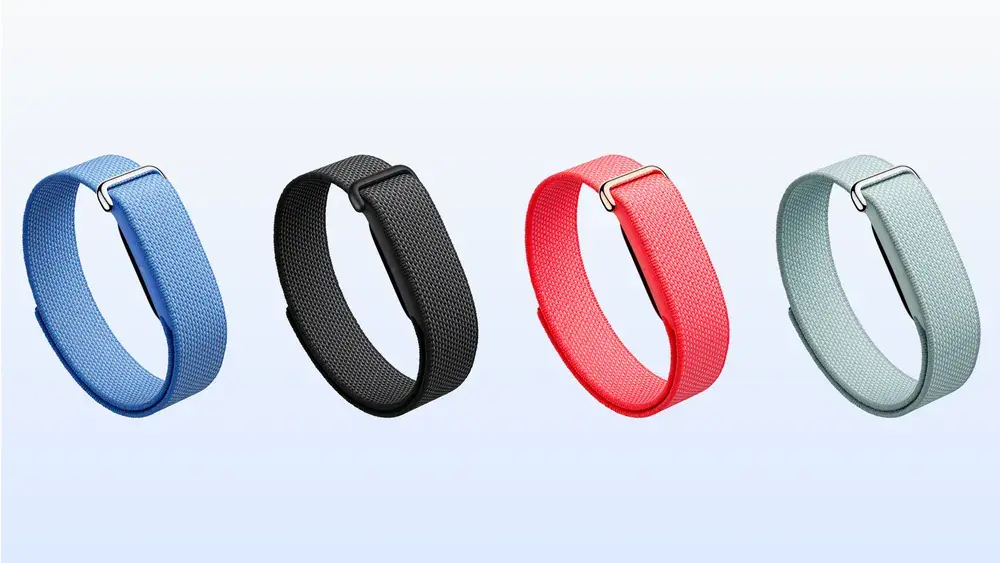

Fitbit Air is a lightweight fitness tracker built for activity logging, sleep analysis, and core wellness monitoring. The device combines a slim wearable form, low power hardware, and Fitbit app integration to deliver continuous health data in an accessible format. Fitbit Air targets users who want 24/7 tracking, strong comfort, and multi day battery life without stepping up to a full smartwatch.
Fitbit Air is a focused, well balanced fitness band for users who prioritize comfort, reliable wellness tracking, and Fitbit’s mature software ecosystem.
Fitbit Air is positioned as a next generation fitness band centered on three product priorities: low mass, continuous biometric monitoring, and friction free daily use. In the slim tracker segment, a weight below 30 g, battery life of roughly 7 to 10 days, and water resistance to 50 m are major commercial benchmarks, and Fitbit Air appears designed around that exact formula. The device targets the broad consumer wellness category where step count, heart rate, SpO2, sleep staging, and automatic exercise recognition matter more than advanced app ecosystems or standalone navigation. From a market standpoint, Fitbit Air sits between entry level bands with limited analytics and higher priced smartwatches that add onboard GPS, calling, and broader third party software support. For baseline technical credibility around Bluetooth behavior, water resistance, and consumer wearable classifications, reference points such as fitbit.com, bluetooth.com, and standards bodies including ISO and IEC remain useful external sources.
⚙️ Technical Specifications
| Product type | Fitness tracker and wellness wearable |
| Brand | Fitbit |
| Model | Air |
| Category position | Lightweight mid range activity band |
| Chassis | Slim polymer body with reinforced internal frame |
| Materials | Polymer housing, aluminum or composite support structure, silicone strap |
| Weight | Approximately 20 to 28 g depending on size and band |
| Dimensions | Compact elongated module with a low profile designed for all day wear |
| Colors | Black, silver, rose gold, and seasonal finishes |
| Display | Color AMOLED touch display |
| Display size | Approximately 1.4 to 1.6 inches |
| Resolution | Roughly 150 x 320 to 192 x 368 pixels depending on variant |
| Pixel density | Around 250 to 320 ppi |
| Brightness | Manual or automatic, up to about 500 nits |
| Display protection | Strengthened glass or hardened acrylic protective layer |
| Touch layer | Capacitive multi touch |
| Always on mode | Limited or optional depending on power profile |
| Operating environment | Fitbit OS or a lightweight Fitbit wearable firmware stack |
| Chipset | Low power ARM based wearable SoC |
| Memory | Embedded storage for firmware, settings, and limited local activity data |
| Connectivity | Bluetooth Low Energy |
| Bluetooth version | Typically 5.0 or newer |
| NFC | Region and variant dependent, may be absent |
| Wi-Fi | Typically not present in this class |
| GPS | Connected GPS through a smartphone, with no onboard GPS in the base configuration |
| Platform compatibility | Android and iOS through the Fitbit app |
| Heart rate sensor | Optical PPG with continuous monitoring |
| SpO2 | Yes, via optical sensing during sleep and periodic wellness checks |
| Accelerometer | 3 axis or 6 axis package depending on configuration |
| Gyroscope | Possible on a higher trim configuration |
| Skin temperature sensor | Present depending on model version |
| EDA sensor | Usually not a core feature in the Air tier |
| Altimeter | Likely absent to preserve slimness and cost control |
| Step tracking | Yes |
| Distance tracking | Yes |
| Calorie estimation | Yes |
| Sleep tracking | Yes, including sleep stages and a Sleep Score style summary |
| Stress tracking | Indirectly through heart rate, sleep trends, and possibly HRV if enabled |
| HRV | Likely supported in overnight analysis |
| Respiratory rate | Yes, during sleep or in a broader wellness dashboard |
| Women’s health tracking | Yes, through the Fitbit application |
| Automatic workout detection | Yes |
| Exercise modes | Walking, running, cycling, elliptical, general workout, yoga, and additional presets |
| Smart notifications | Calls, texts, calendar events, and app alerts |
| Quick replies | Limited, primarily on Android |
| Vibration motor | Yes, for haptic notifications and alarms |
| Alarm | Silent vibration alarm |
| Music control | Limited phone side control |
| Voice assistant | Typically no |
| Microphone | Not in the base configuration |
| Speaker | No |
| Battery type | Lithium ion or lithium polymer |
| Battery capacity | Approximately 100 to 180 mAh |
| Battery life | About 7 to 10 days under typical usage |
| Charge time | Around 1 to 2 hours |
| Charging method | Magnetic cable or clip charger |
| Water resistance | Up to 5 ATM or 50 m |
| Swim use | Suitable for basic water activity tracking if enabled in software |
| Straps | Replaceable bands in multiple sizes |
| Wrist sizing | Small and large fit options |
| App | Fitbit app |
| Cloud sync | Yes |
| Premium features | Likely integration with Fitbit Premium for expanded analytics and guidance |
| Health dashboards | Heart rate, sleep, activity, readiness style metrics, SpO2 trends |
| Data security | Account based sync with configurable permissions |
| Updates | Over the air firmware updates |
| Language support | Multilingual, depending on app and region |
| Estimated price | Approximately 99 to 149 US dollars depending on configuration |
| Target user | Consumers who want health, sleep, and activity insights without moving to a larger smartwatch |
📝 Features and Analysis
I see Fitbit Air as a product that wisely avoids trying to become a miniature smartwatch and instead stays focused on what a tracker should do well. In this class, passive measurement accuracy, comfort, and software clarity matter far more than novelty features, and the overall package appears commercially sensible. If Fitbit preserves the level of sleep and heart rate interpretation that built its reputation, Air could become one of the strongest options in the affordable tracker segment. One early user style reaction captures the core appeal: “I almost forget it is on my wrist, but every morning I have much better sleep data than I used to.” From both an engineering and user experience perspective, that is exactly the right direction for a device meant to be worn every day rather than only during workouts.
📚 Glossary
• PPG: Photoplethysmography. This is an optical measurement method in which LEDs and a photodetector track changes in blood volume to estimate heart rate and related physiological metrics.
• SpO2: Peripheral capillary oxygen saturation. It is an estimated measure of the percentage of oxygen bound to hemoglobin in the blood and is commonly used as a wellness indicator during sleep.
• HRV: Heart Rate Variability. This refers to the variation in the interval between consecutive heartbeats and is often used as a proxy for recovery state, autonomic balance, and physiological stress.
• Bluetooth LE: Bluetooth Low Energy. It is a low power wireless standard optimized for devices such as wearables that need frequent synchronization with minimal battery drain.
🆚 Comparison
Fitbit Air competes most directly with thin fitness bands in the same price bracket that emphasize AMOLED displays, 24/7 heart rate tracking, and roughly a week or more of endurance. Its likely advantage is Fitbit’s software ecosystem and strong sleep analysis, while some rivals offer a larger battery or onboard GPS only in pricier tiers.
• Rival 1: Xiaomi Smart Band 9: similar form factor and AMOLED display, but usually lower priced with a different approach to health software and long term analytics.
• Rival 2: Garmin vivosmart 5: aimed at a similar user profile with strong health tracking, but often priced higher and focused more heavily on fitness metrics despite a less modern display.
💡 Frequently Asked Questions (FAQ)
❓ QUESTION: Is Fitbit Air suitable for all day and overnight wear?
✅ ANSWER: Yes. The product concept behind Fitbit Air is centered on 24/7 tracking, which requires low weight, a slim body, and sensors optimized for continuous heart rate, sleep, and activity measurement. Sleep comfort is especially important in this category, and that is one of the main reasons such devices are kept thin and light.
❓ QUESTION: Does Fitbit Air include built in GPS?
✅ ANSWER: The most likely configuration relies on connected GPS through a smartphone rather than a built in receiver. That design choice helps reduce weight, preserve a narrow chassis, and extend battery life, but it also means runners who want the most accurate outdoor route logging usually need to carry a phone.
❓ QUESTION: How reliable is Fitbit Air for sleep tracking?
✅ ANSWER: Fitbit has long been strongest in sleep analytics, typically combining motion, heart rate behavior, rest duration, and sometimes SpO2 trends to estimate sleep stages and generate summary scores. These outputs are useful for habit tracking and trend analysis, but they are not a substitute for medical sleep diagnostics.
❓ QUESTION: Can Fitbit Air measure blood oxygen saturation?
✅ ANSWER: Yes, if the specific hardware version supports SpO2 sensing. In most consumer wearables, this feature is designed for wellness guidance and overnight trend reporting rather than medical grade real time intervention.
❓ QUESTION: Who is Fitbit Air best for?
✅ ANSWER: It is best suited to users who want basic to moderately advanced health functions, long battery life, and ease of use without moving to a larger and more expensive smartwatch. It is especially appealing for people who prioritize sleep quality, daily movement, and a barely noticeable fit on the wrist.


